The photo shoot that I did at Burton Albion on April 25, 2015 was a really successful shoot during it I took somewhere between 900 and 1000 photos. I came away with ten really strong images, I believe that this was a successful shoot due to the amount of images I have gained compared to previous shoots.
These images I believe are some of my strongest that I have taken during my time at Burton Albion, all of these I took on the 1DX and were using the 70-200mm lens. This image was taken with a shutter speed of 1/500 of a second, one main reason I like this is because you can see the rain pouring down, one thing I feel I could have improved on in this photograph is the fact that the ball is a little bit blurred this is probably because of the speed it is moving had this image been taken using a faster shutter speed that probably would have helped it a lot and kept the ball looking still whereas here it is quite obvious that it is moving.
This image was taken using the same shutter speed as the image above but this image was a lot easier to capture as the player in the image wasn't moving. Looking at it the image at this size the fans in the background look quite clear and distracting but looking at it at its normal size the rain blurs out the fans, this image is also quite good due to the rain in the image it has been pointed out to me that it looks a little bit like snow and it does. With this image the rain hasn't distorted the player and is still very clear, the quality of image on the player is the same as if there was no rain at all on it and it was a normal image.
Friday, 8 May 2015
Friday, 17 April 2015
Plumb Images
Plumb Images are the company who take the photos for the programme for Leicester City. The company also follow the club all over the world when they play in pre-season they also follow youth teams and training and take photos of them.
Here as the player is celebrating they may have used a different camera all together and not a 1DX as some football photographers will take a Canon 5D Mark III with a 24-70mm lens on to take photos of the celebrations or actions close up so I feel that is probably what they have done here. In terms of shutter speed I would guess it is probably somewhere between 1/250 and 1/500 of a second. I personally had a speed of 1/400 when I took a photo of a celebration so it could be around that sort when it comes to aperture I would say either f/2.8 or f/3.5. The shutter may be higher as the player is running in his celebration whereas in my they weren't so I would guess it be around 1/600 to 1/750.
This photo shows several youth players celebrating a goal, here the players aren't moving that quickly so a shutter speed of around 1/400 is more likely than the image above but because they are likely to have used a 1DX due to the distance away from the photographer but they may have had a Mark III with a long zoom lens on it to take this photo. Here yet again the lettering at the back is a little distracting and if it was blurred out a bit it would be a lot better but this is just a minor thing so it is a really strong image that would be used in a programme regardless.
These photos show that Plumb Images are a company that can produce some really strong football images and just looking at these and others they have produced have made me eager to look through Leicester City's programmes to see what else they have produced.
Bob Martin
Bob Martin is a British photographer who is known for his football work he has worked taken photos at many different Premier League grounds along with this he has also been to several FIFA World Cups beginning as early as the 1970s. Martin is a huge inspiration in my work as he has been to several huge events and has taken some of the best football images that I have seen.
This image is one of my favourite that Martin has taken this is because it shows the aftermath of a tackle during a game between Watford and Man United. The main reason this is again a very strong image is that the fans in the background who are Watford supporters would be wearing yellow which is a bright colour but in this image they aren't distracting it doesn't take your eyes away from the action of the image that you are supposed to be looking at and in sports photography it is vital that the background is blurred out and not distracting to you.
This photo was taken at the 2010 FIFA World Cup at a match between Argentina and Mexico. This photo I really like because it shows the two players battling for the ball and the Mexican player is using a rather unorthodox method of trying to get the ball in mid-air this is something you would normally do if the ball was on the ground or off the ground a bit but not like this. Here again he has blurred out the crowd and that isn't distracting I also like expression he has got on the face of the Argentine player I find it quite funny and is kind of makes it a bit of a hilarious image.
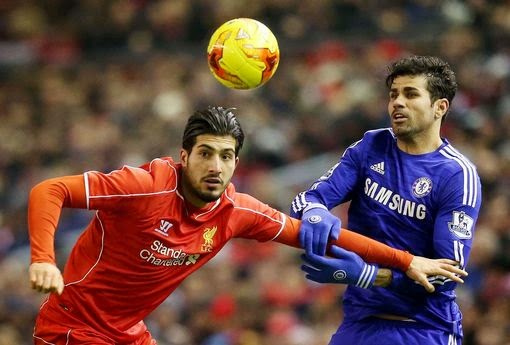
This image shows Liverpool's Emre Can (in red) and Chelsea's Diego Costa (in blue) battling for the ball in a Premier League during the current Premier League season. The reason I like this image is because from this size it looks like Can has intense focus on his face at the ball and that Costa isn't looking at the ball, whereas if you look at an enlarged version of the photo neither player is looking at the ball which I find quite interesting as normally you would expect in a match. He has focused on the players I haven't seen a football photo with the crowd blurred out so much and of course this is vital.
Martin doesn't specify what equipment he uses when he takes his football photos but I would presume he would use a Canon 1DX as after I have met say that the best camera to use for football photography is the 1DX and that most football photographers use it and very few actually use Nikon's. When it comes to lens I would guess he probably uses either a 100-400mm or a 200-400mm lens as these are the most popular for sports photographers to use it could also be a 70-200mm lens as I know a fair few sports photographers who use them.
This image is one of my favourite that Martin has taken this is because it shows the aftermath of a tackle during a game between Watford and Man United. The main reason this is again a very strong image is that the fans in the background who are Watford supporters would be wearing yellow which is a bright colour but in this image they aren't distracting it doesn't take your eyes away from the action of the image that you are supposed to be looking at and in sports photography it is vital that the background is blurred out and not distracting to you.
This photo was taken at the 2010 FIFA World Cup at a match between Argentina and Mexico. This photo I really like because it shows the two players battling for the ball and the Mexican player is using a rather unorthodox method of trying to get the ball in mid-air this is something you would normally do if the ball was on the ground or off the ground a bit but not like this. Here again he has blurred out the crowd and that isn't distracting I also like expression he has got on the face of the Argentine player I find it quite funny and is kind of makes it a bit of a hilarious image.
This image shows Liverpool's Emre Can (in red) and Chelsea's Diego Costa (in blue) battling for the ball in a Premier League during the current Premier League season. The reason I like this image is because from this size it looks like Can has intense focus on his face at the ball and that Costa isn't looking at the ball, whereas if you look at an enlarged version of the photo neither player is looking at the ball which I find quite interesting as normally you would expect in a match. He has focused on the players I haven't seen a football photo with the crowd blurred out so much and of course this is vital.
Martin doesn't specify what equipment he uses when he takes his football photos but I would presume he would use a Canon 1DX as after I have met say that the best camera to use for football photography is the 1DX and that most football photographers use it and very few actually use Nikon's. When it comes to lens I would guess he probably uses either a 100-400mm or a 200-400mm lens as these are the most popular for sports photographers to use it could also be a 70-200mm lens as I know a fair few sports photographers who use them.
Thursday, 16 April 2015
Introduction
The following project is the FMP (Final Major Project) and for this project we have free range of what we want to do and for this project I will creating a programme about Burton Albion. The main plan for this assignment is to go to the final home game of the season to get more images to create the programme. The plan is to look at a range of different programmes newer and older and then decide on how I will be setting out my programme, I will be going back to Burton for the final home game so with this one chance I will need to get the best images but I have been getting better every game so hopefully I will be able to continue this.
With many different ideas in my head of what I can do and about 9 or 10 weeks it should be a really enjoyable assignment and should go really well.
Proposal
For my FMP I
will be creating a programme for Burton Albion. This will also work with my
printed book project as a lot of those photos were from Burton Albion this will
prove to be a great opportunity to use my images from the numerous games that I
have been to. When it comes to using photos from old shoots I plan to use
photos from these shoots that I didn’t use in my book project to allow new
photos from those shoots to be viewed.
I will also have the chance to go back
to the final home game of the season to get more photos. My end point for this
project will be to create a professional looking programme detailing Burton
Albion, my programme will not necessarily be in the current style of the clubs
programmes but the plan is to design to look similar to how most programmes
look.
When it comes
to research I will not only be looking at modern Burton Albion programmes I
will be looking at a variety of different programmes from different clubs and
different eras this I believe will give me plenty of ideas on how to design my
programme. I will also be looking into a wide range of different football
photographers different to those I have looked at before. By looking at these
photographers it will allow me know what is the correct way to lay out my
programme and what sort of photographs would be considered good enough to get
into a programme and what I should be looking out for when taking my photos.
When it comes
to the required equipment this will need to be the sort of camera that is
capable of not only a high shutter speed to capture the fast flowing action of
the football but also would need to take a high quality image for this I will
be requiring either a Canon 5D Mark III, which I do have or a Canon 1DX which I
have borrowed from college before so getting a hold of this equipment will be
no problem. All of my shoots will be done out on location and with just one
shoot possible I will manage my time around making sure that I get the editing
aspect and choosing the images early on instead of waiting until the end, this
is so I can do all the written work and set up a plan of how I am going to set
this out early in the project. The vital part is making sure I have the
programme all set out on a template and ready to make quite early on within the
first four or five weeks of the project.
The way I will
be choosing my images is I will compare them to other football images I have
taken I will look at the quality of the images whether it is focused on the
correct players and make sure that the background is not too distracting I will
try and edit the images if there are any minor problems that can be easily
fixed like tilting the image or brightening it up a bit.
I will
consider my work a success if I feel that my photos are on the same level as
those in official club programmes and others that professional football
photographers take. When it comes to the actual programme I will consider this
a success if it looks a professional standard I will be comparing this to
official programmes it will need to be the correct colours that are normally
used in most professional programmes.
Week by Week Plan
Week 1 (13 April) - Complete proposal and introduction, begin
research, have at least two done by this pointWeek 2 (20 April) - Continue with research, plan weekend shoot, have around 4-5 research artists done. First shoot
Week 3 (27 April) - Begin choosing photos to use in programme, continue research at least 8 done by end of week
Week 4 (4 May) - Edit any photos that need editing, complete research. Begin creating programme
Week 5 (11 May) - Make sure images are selected and final images are edited
Week 6 (18 May) - Review week
Week 7 (25 May) - HALF TERM; continue with work
Week 8 (1 June) - Critique
Week 9 (8 June) - Complete final piece(s) by end of the week
Week 10 (15 June) - End of year show
Week 11 (22 June) - Ensure everything is completed by the end of the week
Subscribe to:
Posts (Atom)


